

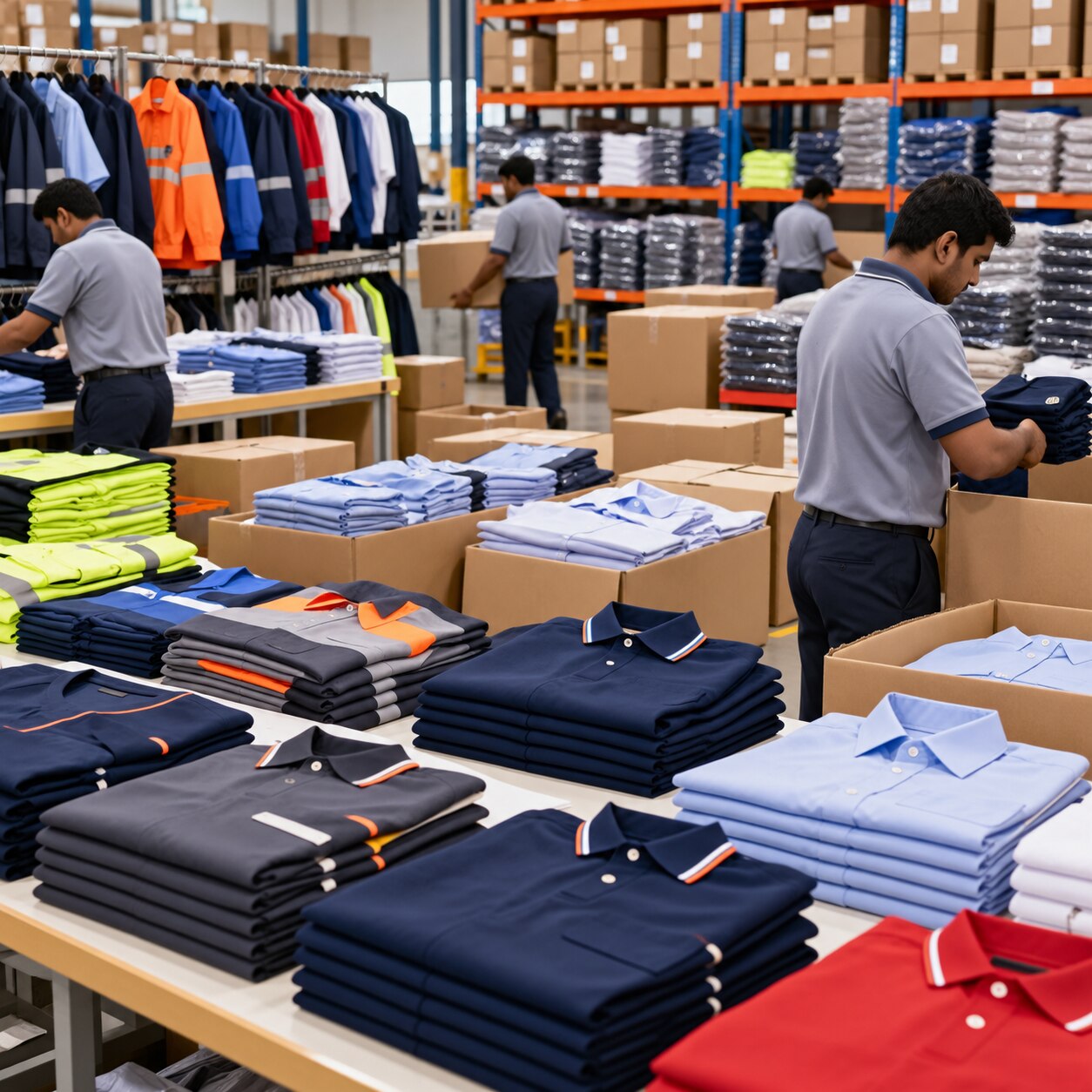
A large uniform order is not defined by a round number alone: style variations, employee sizes, joining dates and replacement needs determine whether consolidation will save money or create excess stock. By the end, you will be able to estimate your real quantity, identify the procurement model that fits, compare landed costs and test whether a Bangalore supplier can deliver consistently.
Key takeaways
- Count each style-colour combination against the supplier’s MOQ.
- Use wholesale procurement when demand is standardised and delivery dates are flexible.
- Add freight, alterations, packaging, taxes, rejects, and rework to the quoted price.
- Request production samples, capacity evidence, references, and a written fulfilment schedule.
How large is “large quantity” for a uniform order?
A 1,000-piece uniform order is not automatically large. If those garments span ten style-colour combinations, a supplier may apply the uniform MOQ to each variant, making the demand equivalent to ten smaller orders. Large quantity uniform procurement begins when demand is consolidated by style, fabric and colour.
1. Count current employee headcount by role, gender and required garment. Add confirmed joiners by delivery month, not speculative hiring. Record active stock, onboarding stock, reserve stock and replacements separately.
2. Build uniform size distribution from employee measurements or reliable issue records. Do not divide quantities equally across sizes; that creates shortages in common sizes and dead stock in others.
For each role, calculate issued quantity, add scheduled joiners, then apply a planned replacement percentage based on garment use, washing frequency, turnover and the months before the next order.
3. Add a small operational reserve and check the uniform MOQ for every style-colour combination. A shirt, trouser and jacket in three colours can create separate thresholds even when the total garment count looks substantial.
4. Choose one complete release when price and shade consistency matter more than inventory risk. Choose phased releases when workforce or size demand is uncertain, while allowing for fabric-lot changes, trim availability and price variation.
The order is genuinely large when consolidated demand meets supplier MOQs and justifies sampling, specification work and coordinated delivery—not merely because one department has many workers.
When is a Bangalore uniform wholesaler the right procurement model?
A Bangalore uniform wholesaler is the right model when you need repeatable garments at scale and can freeze the design, colour, fabric and branding method. Check MOQ per style-colour combination: 1,000 garments split across ten variants may be priced as ten smaller orders.
| Option | What it means | When it fits |
|---|---|---|
| Wholesale sourcing | Ready-made garments bought in volume | Standard designs with limited fit and construction control |
| Bulk uniform stitching | Garments made to an agreed pattern and specification | Repeatable custom uniforms across sites or departments |
| Contract manufacturing | A supplier produces to your specification, using your materials or labels when agreed | Controlled branding, materials and recurring production |
| Ready-made resale | Existing stock selected from a supplier’s range | Fast deployment where customisation is limited |
The model suits multi-site rollouts, seasonal hiring, school or college admissions, contractor workforces, recurring replenishment and urgent replacement orders. It also works when several locations combine demand under one approved specification and release schedule.
Choose another route when the order does not match that structure:
- A local tailor suits small batches or individual alterations, but lacks consolidated production throughput.
- A retail supplier offers convenience, but usually charges more for smaller quantities and limited customisation.
- A direct factory order suits very high, stable volumes, but can bring higher MOQs, longer coordination and less local support.
Uniform wholesalers Bangalore searches can identify suppliers, but locality is not the decision. Select the supplier whose MOQ, delivery window and customisation level match your demand; “bulk” is not automatically cheaper.
When should you avoid wholesale uniform procurement?
Do not make a conventional wholesaler your default for specialised protective workwear. Heat-, flame-, chemical- and high-visibility garments require the specified Indian or international performance standard, certification, labels and test evidence; stitching capability proves none of these.
1. Avoid wholesale when the order is a low-volume pilot, involves unusual body proportions, changes design frequently or has not completed wearer trials. Start with a size-set sample, then approve a pre-production sample made from the intended fabric, trims, branding method and construction.
A showroom sample made with substitute fabric cannot prove bulk fit or appearance.
2. Prepare a uniform tech pack before requesting production quotations. Include fabric composition and weight, colour reference, construction, seams, pockets, trims, artwork, labels, measurement chart and tolerances. A description such as “formal shirt” leaves too many decisions open.
3. Specify wash testing when fit or colour matters. ISO 6330 uniform testing defines domestic washing and drying procedures; pair it with ISO 5077 for dimensional change and applicable ISO 105 colourfastness methods. Skipping these checks can leave you with shrunken garments, displaced embroidery or dye transfer.
4. Require shade approval and dye-lot identification for repeat orders. If you cannot freeze the specifications, use a smaller pilot or local alteration-led approach instead of committing to wholesale quantities. Otherwise, a changed fabric lot or unapproved construction can make the entire replenishment visibly inconsistent.
How should you compare quotations and calculate the real landed cost?
A uniform supplier comparison is valid only when every quotation uses the same fabric, colour, measurement chart, branding artwork, labels, packaging and delivery location. Record unit price, MOQ per style and colour, sample approval process, alteration support, size exchanges, repeat-order consistency, delivery capacity and payment terms.
- Split uniform lead time into artwork and specification approval; sample production; fabric and trim procurement; cutting; stitching; embroidery or printing; finishing; inspection; packing; and transport. A “15-day stitching time” hides delays from imported trims, sample revisions and rework.
Calculate uniform landed cost per usable garment, not the quoted garment price. Include fabric or garment cost, pattern development, embroidery or printing, labels, packaging, freight, GST, alterations, rejected pieces, storage, rush delivery, excess sizes left unused, and internal time spent measuring, approving samples and handling exchanges.
Branding choice affects durability, comfort and rework:
| Option | Best use | Main risk |
|---|---|---|
| Embroidery | Durable raised logos | Stiffens lightweight fabric and distorts small lettering |
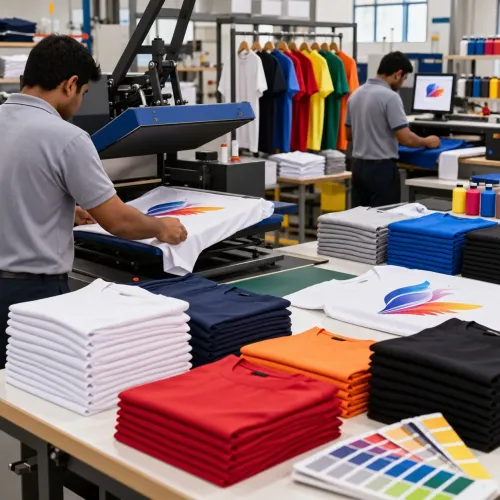
| Heat transfer | Fine detail | Requires adhesion and wash testing |
| Screen printing | Repeated larger graphics | Less suitable for complex multicolour artwork |
For one release, compare the lower unit cost with excess-inventory risk. Phased quantities reduce that risk but can create fabric-lot, trim-availability and price differences; require shade approval and lot identification for repeat orders.
What evidence proves a wholesaler can fulfil the order?
Evidence of uniform supplier capacity is a documented production plan, not a claim that the order is “manageable.” Ask the supplier to map your delivery window through cutting, stitching, branding, finishing, inspection and dispatch.
| Stage | Evidence to request | Failure exposed |
|---|---|---|
| Capacity | Machine numbers and types available during your window | Hidden bottlenecks |
| Workflow | Dates for fabric, cutting, stitching, branding, finishing and dispatch | Unrealistic lead time |
| Quality control | Checkpoints, inspection records and the person approving bulk output | Uncontrolled rework |
| Subcontracting | Operation outsourced, subcontractor controls and liability for defects | Responsibility gaps |
Inspect a completed or in-process comparable order. Request anonymised inspection records, compare the approved pre-production sample with bulk pieces, and test whether the supplier reproduces the pattern, bill of materials, measurement chart, artwork, thread references and fabric specification. Ask who retains these records for repeat orders.
Colors Inc becomes worth evaluating as a Bangalore uniform supplier when local approvals reduce friction and its evidence passes these checks.
Put acceptance rules in the purchase order. Define:
- Critical, major and minor defects
- Inspection method, sample size and acceptance limits
- Measurement tolerances and shade variation
- Missing sizes, damaged branding, under-delivery and over-delivery
- The deadline for reporting defects
ISO 2859-1 can provide a sampling scheme for quality control for bulk uniforms, but an AQL value does not promise defect-free garments or inspection of every piece. The contract must state the remedy for rejected output.
Related service
college uniforms We undertake uniforms stitching for both men and Women View service → |
Frequently asked questions
How large is large quantity for a uniform order?
A large order depends on how demand is consolidated by style, fabric, and colour. A 1,000-piece order split across ten variants can behave like ten smaller orders because MOQs may apply to each variant.
When is a Bangalore uniform wholesaler the right procurement model?
Choose wholesale procurement when you need repeatable garments in standardised specifications, have enough volume to meet variant-level MOQs, and can plan delivery around production lead times.
When should you avoid wholesale uniform procurement?
Avoid it when sizes, colours, styles, or branding details vary widely; demand is uncertain; storage is limited; or you need small, urgent replenishments.
How should you compare uniform quotations and calculate the real landed cost?
Compare the garment price plus freight, taxes, packaging, alterations, sampling, embroidery or printing, inspection, rejects, rework, and storage. Divide the complete order cost by accepted garments, not pieces shipped.
What evidence proves a wholesaler can fulfil the order?
Request a production sample, fabric and trim specifications, variant-level capacity confirmation, a written delivery schedule, quality inspection terms, business references, and records showing how shortages and rejected garments are handled.