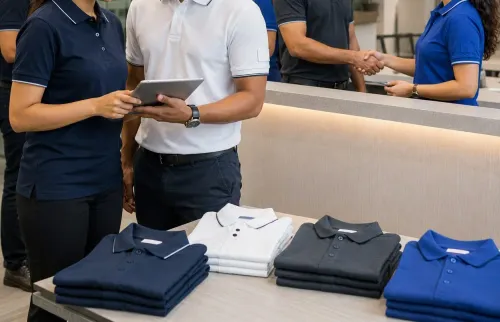


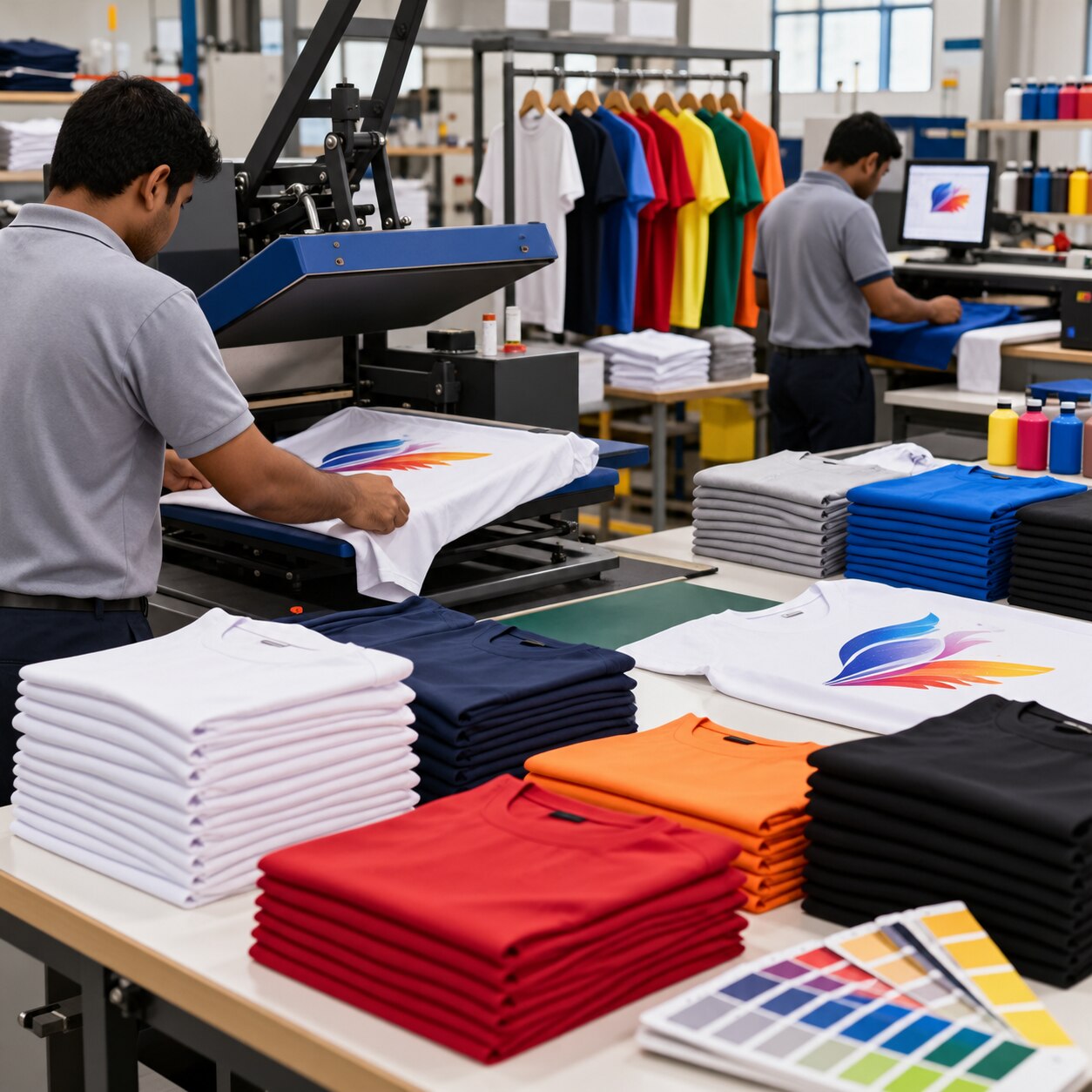
Choosing a T-shirt printer involves more than finding the lowest per-piece price: the fabric, artwork, decoration method, placement and washing process all affect the result. By the end, you will know how to prepare your logo, compare quotations, approve a sample and order promotional apparel with fewer surprises.
Key takeaways
- Choose screen printing for large, simple-colour cotton runs.
- Send vector artwork and confirm placement measurements before production.
- Compare fabric weight, fit and size mix before requesting quotes.
- Approve a physical sample and inspect print adhesion at delivery.
Choose the printing method for your fabric, artwork and order size
Match the T-shirt printing methods to the fabric, artwork and quantity before comparing prices. Screen printing suits large cotton or cotton-rich runs: each ink colour needs a screen, setup and alignment, so extra colours raise setup time and cost. It gives efficient, durable production but is less suitable for small orders or changing names.
| Method | Best fit | Main control or risk |
|---|---|---|
| Screen printing | Large runs, bold logos, cotton and blends | Cure plastisol fully; polyester can suffer dye migration |
| Direct-to-film transfer | Small or medium runs, multicolour art, variable names | Control film, adhesive powder, temperature, pressure and peel |
| DTG printing | Detailed artwork and small cotton orders | Pretreatment and white ink determine dark-garment opacity and wash life |
| Heat-transfer vinyl | Simple graphics, names and low quantities | Cut colours separately; edges and fine detail limit the design |
| Embroidery | Polos, jackets and durable branding | Lightweight jersey can pucker, distort or develop holes |
DTF works across cotton, polyester and blends when the transfer is pressed at the supplier’s specified temperature and pressure, then peeled at the correct stage. A DTG printing uniform printing Bangalore search does not replace a fabric test; white-ink pretreatment must be dried and heat-pressed correctly or marks and poor wash performance follow.
Cure screen ink through its full film, and test low-bleed underbase systems on polyester or sublimated garments. Wash-test a complete sample in the final colour before approving bulk production.
Prepare logo artwork and specify a placement that will reproduce accurately
1. Send logo artwork for T-shirt printing as a vector logo file in AI, EPS, PDF or SVG format. Convert editable text to outlines, remove hidden layers, and specify CMYK or spot colours with Pantone references.
Supply photographic artwork at 300 dpi at its final print size, with a transparent background where the shirt fabric must show through.
2. Simplify fragile details before approval. Thin lines, small lettering and tightly spaced reverse text fill in, break up or become unreadable during printing and embroidery; ask the printer to state minimum stroke width and letter height. Approve a physical strike-off or sew-out, not only a screen preview.
- Left chest: 8–10 cm wide, measured from the centre front and 16–20 cm below the shoulder seam.
- Centre front: 25–30 cm wide, centred between side seams and measured from the collar seam.
- Back: 25–30 cm wide, positioned 5–8 cm below the collar seam.
- Sleeve: 7–9 cm wide, measured from the sleeve hem or shoulder seam.
- Pocket area: fit the logo within the pocket panel, leaving at least 1 cm clearance from its edges.
4. For mixed sizes, specify graded placement by garment size rather than one fixed collar distance; record tolerances in millimetres or centimetres. Check the decorated sample after a defined wash-and-dry cycle because shrinkage and skew shift the logo.
A Pantone colour matching reference cannot guarantee identical colour across ink, thread, transfer film and fabric. Approve a physical sample on the specified garment and define the acceptable colour tolerance.
Select the T-shirt fabric, weight, fit and size mix before decorating
Choose the blank for its working conditions, not only its appearance. Cotton promotional T-shirts feel comfortable and absorbent for indoor staff or short events; polyester manages sweat, dries quickly and suits outdoor activity; cotton-rich blends balance softness, drying speed and shape retention.
| Material | Comfort and performance | Shrinkage, colour and printing |
|---|---|---|
| Cotton | Soft, breathable and absorbent | Can shrink; screen printing and DTG suit it well |
| Polyester | Light, quick-drying and colour-stable | Resists shrinkage; use polyester printing, but test dye migration |
| Cotton-rich blend | Softer than polyester with better drying than cotton | Moderate shrinkage; test print adhesion and colour stability |
T-shirt fabric GSM affects opacity, drape, durability and heat retention: 140–160 GSM is light and cooler, while 180–220 GSM feels more substantial and hides show-through. Regular fit gives predictable logo placement; relaxed fit moves the logo farther from the body’s centre, while slim fit makes the same artwork appear lower or tighter.
Match garment colour to the brand palette. Dark shirts need a white or blocker underbase for opaque light ink; sublimated polyester can cause dye migration after heat exposure, so demand a low-bleed test and laundering check.
Build the T-shirt size mix from the wearer list; for campaigns, use audience history or a short size survey, group counts by size, then add 3–5% reserves for replacements. Specify:
- Fibre composition, GSM or construction, colour, size range, fit, permitted substitutions and care-label information.
- Record the exact style, not “same as sample”; approve substitutions in writing before production.
Compare T-shirt printers on the quote, sample and durability evidence
Compare T-shirt printers on the same written specification, not on a low headline price. A minimum order quantity printing quote for custom logo printing should identify every cost and assumption before you compare one promotional apparel supplier with another.
- Record garment style, fibre composition, colour, size range, decoration method, print positions, ink or thread colours, logo dimensions, artwork or setup charges, sample cost and minimum order quantity.
- Require the per-piece price, taxes, packaging, delivery charge, turnaround time, replacement terms and reprint terms. Ask whether substitutions need your written approval.
- Ask how the printer controls screen curing, DTF transfer temperature, pressure, dwell time and peel timing, DTG pretreatment and white-ink application, or embroidery backing and puckering.
| Method | Evidence to compare | Failure to detect |
|---|---|---|
| Screen printing | Cure temperature, dwell time and colour registration records | Cracking or washing-off from under-cured ink |
| DTF | Film, adhesive powder, heat, pressure and peel settings | Lifting edges or a stiff, cracked transfer |
| DTG | Pretreatment method and drying control | Faded dark-garment prints |
| Embroidery | Backing type and test sew-out | Puckering on lightweight jersey |
Request a complete decorated sample in the final garment colour and size, plus a wash-tested piece. Get written colour-tolerance limits; Pantone alone cannot guarantee identical ink, thread or transfer colour on fabric.
Before choosing Colors Inc, confirm it accepts standalone T-shirt printing orders, supplies your chosen blanks, provides physical approvals, and records the final specification rather than relying on a digital mock-up.
Related service
college uniforms We undertake uniforms stitching for both men and Women View service → |
Use a controlled ordering and inspection process from proof to delivery
A controlled T-shirt order process leaves no production decision to memory. Record the exact garment style, fibre composition, GSM, colour, size range, decoration method, logo dimensions, placement measurements, packaging and permitted substitutions.
- Submit final artwork and the garment specification.
- Approve the digital proof approval for layout, spelling, print positions and proportions.
- Inspect a physical sample in the final garment colour and size range.
- Confirm colour references, strike-off results and placement measurements in millimetres or centimetres.
- Wash and dry the sample using the defined care cycle; approve the wash result only after checking shrinkage, skew, peeling, cracking and colour change.
- Release bulk production only after recording the final specification and signed approvals.
Define the inspection lot, sample size, inspection level, defect categories and acceptance criteria before delivery. ISO 2859-1 can structure apparel quality inspection ISO 2859-1 sampling, but an AQL is not permission to ship a fixed percentage of defective pieces.
| Inspection area | Check | Classify as |
|---|---|---|
| Garment identity | Style, colour, fibre, sizes and cartons | Critical mismatch |
| Decoration | Position, logo dimensions, spelling and print method | Major defect |
| Finish | Cracks, peeling, stains, puckering or misprints | Major or minor defect |
On arrival, count cartons and reconcile the delivery note against garment style, colours, sizes and quantities. Require packing by size, care instructions, batch or order references, and replacement instructions; hold payment completion until inspection where the contract permits. Record shortages and defects with photographs, isolate affected pieces, and obtain a dated replacement or reprint commitment.
Frequently asked questions
Which T-shirt printing method suits my order?
Match the method to fabric, artwork and quantity. Screen printing suits large cotton or cotton-rich runs, while small orders, changing names or detailed multicolour artwork need a different process.
How should I prepare a logo for T-shirt printing?
Provide clean vector artwork, confirm the print colours and specify placement with measurements from fixed garment points, such as the collar seam or side seam.
What should I compare when choosing T-shirt fabric?
Compare fibre content, fabric weight, fit and the size mix your team needs before decoration. The chosen fabric affects comfort, appearance and print performance.
How can I check a T-shirt printer before placing a bulk order?
Compare the written quote, approve artwork and placement proofs, request a representative sample and inspect print durability, garment sizing and order quantities before delivery.