

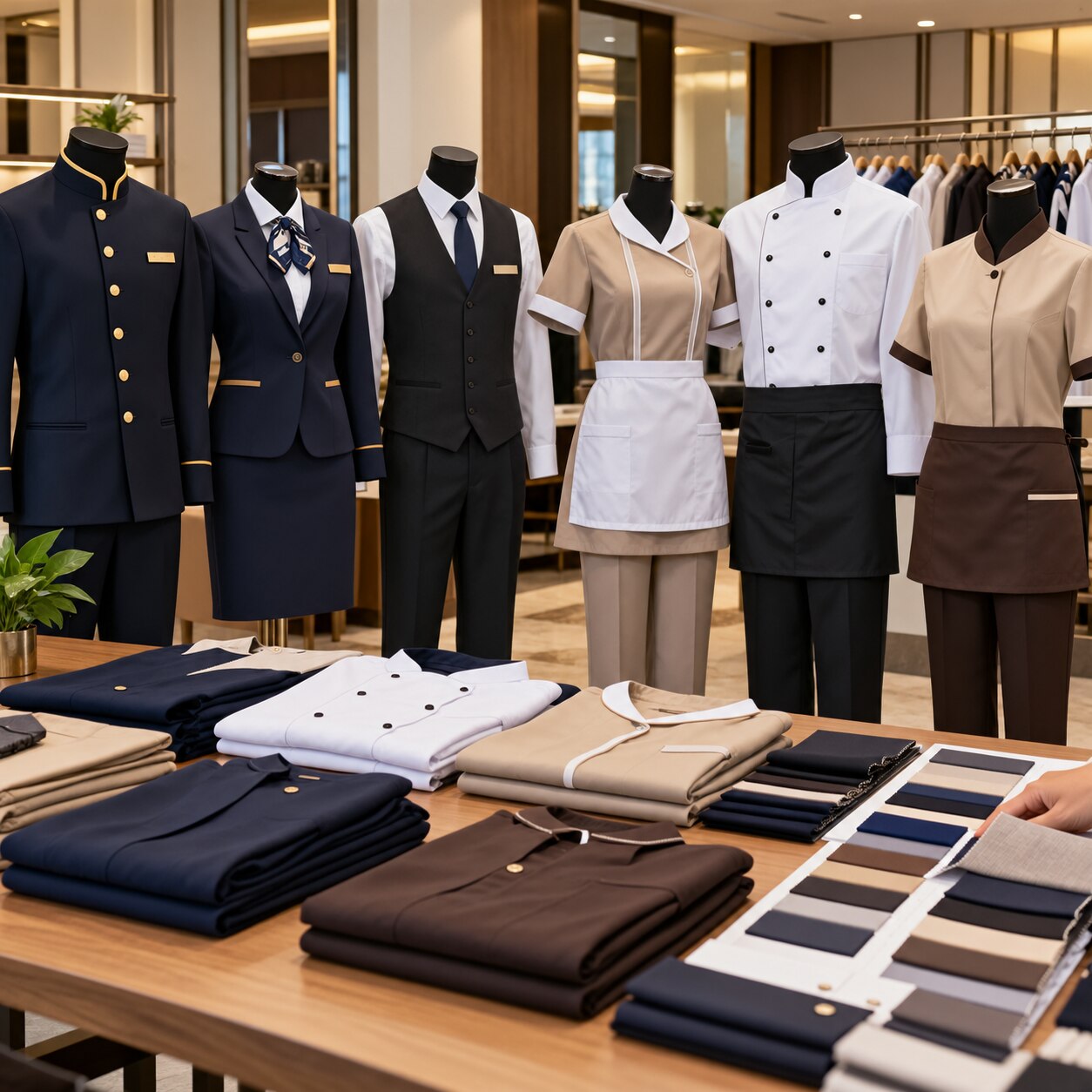
A hotel cannot choose one uniform specification for every department: front office staff need polished drape, housekeeping teams need durable movement-friendly garments, and service staff need comfort through repeated washing and long shifts. By the end, you will have a role-by-role specification, sampling checklist and supplier comparison method for approving uniforms before bulk production.
Key takeaways
- Specify separate uniforms for front office, housekeeping and service roles.
- Compare fabric by abrasion, stain, drying and laundering performance—not GSM alone.
- Test samples on real staff sizes during full shifts before bulk approval.
- Calculate delivered cost, replenishment lead time and spare-stock protection.
Compare the Three Hotel Roles Before Comparing Manufacturers
Treat front office, housekeeping and service staff uniforms as three specifications, not one hotel-wide outfit. Each role faces different movement, soil, visibility and laundering demands.
Your search for hotel uniform manufacturers Bangalore should produce separate fabric-and-garment proposals for each role.
| Role | Cut and movement | Fabric, colour and branding | Construction priority |
|---|---|---|---|
| Front office | Tailored shirts, blazers, trousers or skirts with a polished drape and comfortable sitting fit | Colour-consistent, breathable fabric; restrained embroidery or name badges; dark shades need wet-rub and perspiration colourfastness checks | Clean seams, stable collars, accurate grading and a consistently professional silhouette |
| Housekeeping | Roomy armholes, practical trouser rise and unrestricted bending, reaching and pushing | Abrasion-resistant, stain-tolerant fabric in colours that hide working soil without looking untidy; use easy-care finishes | Reinforced pocket corners, bartacks, strong side seams and construction that withstands commercial laundry |
| Service staff | Comfortable fit for walking, lifting trays and long shifts without excess fabric catching on equipment | Low-wrinkle, breathable fabric with repeated-wash colour retention; keep logos and trim neat after pressing | Secure pockets, durable hems, stable waistbands and finishing that tolerates tumble drying and pressing |
Front office uniforms usually reveal shade variation and wrinkling first, while housekeeping uniforms fail at seams or show abrasion. Service staff uniforms expose shrinkage, collar distortion and discomfort during extended wear.
Ask for a size set in the smallest, middle and largest required sizes, then fit actual employees or a representative panel. Test every role through the hotel’s laundering route, including stain chemicals, industrial washing, tumble drying and pressing. Approve a signed lab-dip standard rather than a showroom swatch alone.
Specify Fabric Performance Instead of Choosing by GSM Alone
A 65/35 polyester-cotton hotel uniform fabric at 180 GSM is not automatically durable. Specify test results after the hotel’s actual wash formula, tumble-drying temperature, pressing heat and stain-treatment chemicals, because domestic washing will not expose commercial failures.
| Role | Fabric priority | Minimum evidence to request |
|---|---|---|
| Front office | Drape, shade consistency, breathable uniform fabric and low wrinkling | Dimensional change within 3% after laundering; colour change and staining grade 4 or better under ISO 105-C06 |
| Housekeeping | Abrasion resistance, stain tolerance and movement | Martindale abrasion result agreed for the role; pilling grade 4 after ISO 12945-2; dry-rubbing grade 4 and wet-rubbing grade 3 under ISO 105-X12 |
| Service | Repeated washing, comfort and easy pressing | Shrinkage within 3%; perspiration colourfastness grade 4 under ISO 105-E04; no coating, print or seam delamination after the approved wash route |
Ask for laboratory reports against ISO 5077 and ISO 6330 for shrinkage control, ISO 105-C06 for washing colourfastness, and ISO 105-X12 for rubbing. Set acceptance limits before sampling; otherwise a supplier can present a passing result with no agreed pass line.
- Test a pre-production garment made from the intended bulk fabric, trims, embroidery thread and labels.
- Wash that garment through the outsourced laundry’s real cycle, including bleach or stain chemicals, tumble drying and pressing.
- Inspect shade, embroidery puckering, button colour, seam distortion and fabric hand after five to ten cycles.
- Approve a signed physical swatch from the dye lot; a Pantone code or screen image cannot control hotel lighting and optical-brightener effects.
GSM remains a reference, not a durability specification. Check stitch density, pocket bartacks, side-slit reinforcement and seam quality separately.
Approve Fit, Pockets and Construction Across Real Staff Sizes
Approve the pattern only after a uniform size set has been fitted on real male and female staff, not after reviewing one medium sample. A medium garment can hide restricted armholes, a short shirt, an incorrect trouser rise, skirt pulling and poor grading at extended sizes.
1. Request the smallest, middle and largest required sizes for each garment. Record chest, waist, hip, shoulder, sleeve, inseam, skirt and finished-garment lengths on the measurement chart. Set tolerances for every measurement; a body-size chart alone does not control the ease delivered.
2. Conduct hotel uniform fitting while staff walk, bend, reach overhead, sit and climb stairs. Check armhole mobility, bust and hip shaping, trouser rise, waistband pressure, skirt movement and shirt length. Test men’s and women’s blocks separately rather than scaling one pattern across both.
3. Verify uniform pocket placement with the objects staff carry. Housekeeping pockets must remain reachable without pulling the garment; service pockets must not catch trays or aprons; front-office pockets must preserve a clean silhouette. Add bartacks at pocket corners and inspect reinforced seams at side slits, crotches, armholes and waistband joins.
4. Wash and wear samples before approval. Check twisted seams, loose threads, puckering, button security, zipper operation, hem stability and shape retention after laundering. A high-GSM fabric will not prevent failure when stitch density, thread quality or seam finishing is poor.
5. Require the manufacturer to retain the approved pattern, size chart, reference garment, embroidery artwork and trim specification. Confirm how replacement sizes will match the original block and shade.
Use a Sample-to-Bulk Approval Process That Tests Real Hotel Wear
Approve one pre-production sample before committing to bulk, then test it on the staff member and shift it is meant to serve. Uniform manufacturer sampling proves little if the sample uses substitute fabric, trims or thread.
1. Request a pre-production sample in the intended bulk fabric, colour, buttons, zippers, labels, embroidery thread and print method. Check shade against a signed physical swatch from the approved dye lot; a screen image or Pantone reference cannot control production lighting.
2. Fit the sample on representative front office, housekeeping and service employees. Record chest, waist, hip, sleeve, trouser and garment lengths, then check movement, pocket access and comfort after a full shift.
3. Inspect stitching at collars, cuffs, seams, pockets and stress points. Wash the sample using the hotel’s actual process and check shrinkage, colour bleeding, embroidery puckering, print cracking, button damage and seam opening.
4. Mark hotel uniform embroidery and uniform logo placement on the approved sample. Confirm artwork size, thread colour, print position and orientation so replacements do not arrive with visibly inconsistent branding.
5. Agree a signed alteration and replacement procedure. Keep the approved pattern, measurement chart, artwork, trim specification and reference garment; ask whether replacements use reserved fabric, the same mill or a new dye lot.
Use a written bulk inspection plan with lot size, sample size, measurement tolerances and critical, major and minor defect definitions. Colors Inc should be assessed by this evidence, not by a low stitching rate or verbal promise of quality.
Compare Delivered Cost, Capacity and Replenishment Protection
A lower stitching rate can still produce the higher hotel uniform cost. Compare the delivered price after fabric consumption, embroidery, buttons, zippers, sampling, size-set alterations, packing, Bengaluru transport, GST, defective-piece replacements and emergency stock holding.
| Check | Dependable supplier | Low-rate warning |
|---|---|---|
| Delivered cost | Itemised quote with GST, alterations, transport and replacement assumptions | One stitching figure with extras added later |
| Capacity | Cutting and stitching capacity for your delivery window, production calendar and declared subcontractors | “Fast delivery” without available-machine or workforce details |
| Replenishment | Written small-quantity lead time and uniform replacement policy | No commitment after the launch order |
| Compliance | GSTIN, matching legal name, valid tax invoice, bank account and labour-compliance declarations | Showroom treated as proof of in-house production |
Use this hotel uniform supplier checklist before awarding the bulk order:
- Request the uniform lead time Bangalore in calendar days, including approval, cutting, stitching, embroidery, inspection and transport.
- Ask whether each role receives a separate fabric-and-garment proposal; front office presentation, housekeeping abrasion resistance and service comfort do not share identical priorities.
- Record finished-garment tolerances for chest, waist, inseam, sleeve and garment length, not only body measurements.
- Define wash temperature, detergent, drying method, cycle count and a maximum 2–3% dimensional change before approval.
- Complete uniform supplier GST verification on the GST portal and match the GSTIN, legal entity, invoice and bank-account name.
- Require written defect-replacement timelines and identify who pays for return transport and urgent remakes.
Frequently asked questions
Why should hotels specify separate uniforms for each staff role?
Front office, housekeeping and service staff face different movement, soil, visibility and laundering demands, so one hotel-wide specification creates avoidable compromises.
Why is GSM alone a poor way to compare uniform fabric?
GSM measures fabric weight, not its abrasion resistance, stain response, drying speed, comfort or performance after repeated laundering.
What should hotels test before approving uniform samples?
Test fit, pocket access, movement, closures, seam construction, comfort and laundering across real staff sizes during normal hotel shifts.
How should hotels compare uniform manufacturer costs?
Compare the delivered cost with sampling, alterations, freight, taxes, lead times, production capacity and protection against replenishment delays.