

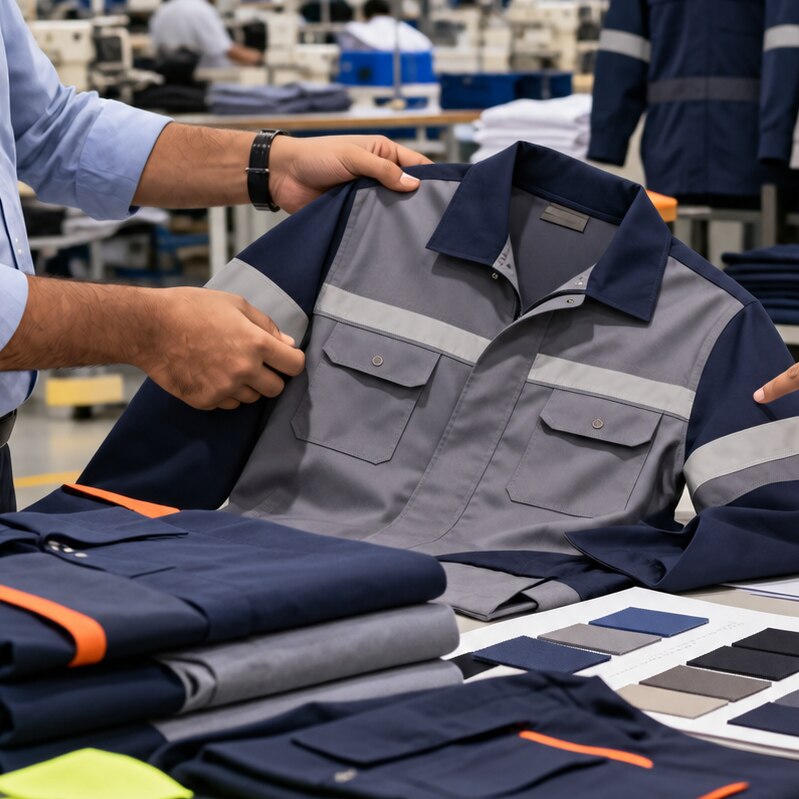
A low garment price does not reveal whether a supplier has the capacity, controls, fabric performance or replenishment process your workforce needs. Use a weighted comparison, inspect the production evidence and approve a fully specified sample before you select a manufacturer or sign a bulk-order contract.
Key takeaways
- Score suppliers against weighted criteria before requesting quotations.
- Inspect factory capacity and document every subcontracting step.
- Compare quotations using one complete bill of materials.
- Test samples, sizing, fabric and replacement support before signing.
Build a weighted comparison before requesting quotations
Score each workwear manufacturer in Bangalore against the same criteria before requesting prices. A useful workwear supplier comparison measures evidence, not promises: use a five-point score for every criterion, multiply it by the weight, and record the document or sample supporting the score.
| Criterion | Weight | Evidence to request |
|---|---|---|
| Specification control | 25% | Approved pattern, grading rules, fabric reference, artwork, trims, size chart and tolerances |
| Quality capability | 20% | Fabric composition and GSM, test-wash results, colourfastness, shrinkage, seam construction and inspection method |
| Available capacity | 20% | Production calendar, planned line allocation, cutting and sewing bottleneck, machinery and approved subcontractors |
| Replenishment support | 15% | Retention period for patterns and artwork, repeat-order lead time, minimum replacement quantity and replacement liability |
| Cutting and size coverage | 10% | Usable fabric width, marker efficiency, cutting waste and size-ratio assumptions, including extended sizes |
| Commercial control | 10% | Complete bill of materials, packaging, transport, GST, sampling and alteration assumptions |
For uniform manufacturer evaluation, reject any supplier that will not document critical specifications or disclose who performs cutting, sewing and finishing. A low score on replenishment can disrupt bulk workwear procurement months later, when a few replacement garments become a new development.
Shortlist two or three manufacturers with similar weighted totals, then request quotations against the same approved specification.
Verify the factory, capacity and subcontracting chain
A supplier’s monthly output is not the same as capacity available for your delivery window. A site visit, current production plan and named subcontractors will reveal whether the quoted order can actually be made on time.
1. Visit the stated factory and inspect the cutting floor, sewing lines, finishing area, pressing equipment and packing space. Match the address, machinery and active workforce to the supplier’s claims; a garment factory Bangalore address alone proves little. Ask to see current work-in-progress, not only a showroom sample.
2. Request the production calendar showing planned line allocation, existing bookings, the cutting and sewing bottleneck, and your order’s proposed start and completion dates. Ask for workwear manufacturer capacity, available capacity during your deadline, monthly output by garment type and realistic repeat-order lead time.
An apparently large uniform production capacity is useless if every line is booked before your contract starts.
3. Get the workwear subcontracting chain in writing. Name each approved subcontractor, the operation assigned, inspection responsibility and return-to-factory point. Unapproved embroidery, printing or sewing can change shade, construction and delivery control without appearing in the quotation.
4. Ask whether fabric is stock or made to order. Stock can accelerate the first batch but create shade, lot, width or finish problems on replenishment; made-to-order fabric needs more lead time and can require a higher minimum quantity.
5. Request the cutting plan, including usable fabric width, marker efficiency, expected waste and size-ratio assumptions. A plan built around common sizes can leave extended sizes short.
Compare quotations against one complete bill of materials
A low quote is useful only when every supplier prices the same complete bill of materials. For a practical workwear quotation comparison, request one line for each cost and specification, then audit omissions before judging uniform costing.
| Item | Compare line by line | What a low quote may hide |
|---|---|---|
| Fabric | Fibre blend, fabric GSM and composition, usable width, shade, lot, garment weight and shrinkage limit | Lighter cloth or cheaper fibre |
| Construction | Stitch type, seam allowance, stitch density, bartacks, buttonholes and inspection operations | Fewer operations and faster failure |
| Components | Zips, buttons, elastic, labels, reflective tape and accessories by named specification | Inferior trims or omitted tape |
| Branding | Artwork setup, screen or digitising fee, print area, embroidery stitch count and rework | Sampling or logo charges added later |
| Order services | Sample, size grading, packing, individual labelling, alterations and replacement liability | Unpriced corrections and rejects |
| Logistics | Dispatch point, freight, unloading, insurance, GST and transport in uniform orders | A low ex-factory price that costs more delivered |
Ask for the cutting plan too: usable width, marker efficiency, expected waste and size-ratio assumptions. Otherwise common sizes consume the fabric while extended sizes become shortages or extras.
For high-visibility clothing, replace “reflective uniform” with the claimed ISO 20471 class, conspicuous-material area, tape placement and test evidence. Record the approved fabric lot, artwork, measurements and trim reference, and price replenishment quantities against that record rather than treating every replacement as new development.
Test fabric, construction, samples and workforce sizing
Approve a signed pre-production uniform sample, not a catalogue garment or photograph. Record its fabric lot, shade, composition, GSM, logo artwork, stitch density, construction details and approved accessories; otherwise production can match the appearance while changing the specification.
1. Test workwear fabric quality for fibre composition, GSM, pilling, seam strength and shade consistency. Request colourfastness and shrinkage testing, including dimensional change after laundering under the conditions your laundry uses. ISO 5077 and ISO 6330 provide recognised measurement and wash procedures.
2. Inspect stress points on the sample: pocket corners, belt loops, side seams, crotch, collar, cuffs and zipper attachments. Check skipped stitches, loose threads, puckering, uneven topstitching and logo placement. Specify a wash-life acceptance limit for seam opening, shade change and trim failure.
3. Require a uniform size chart showing finished garment measurements and tolerances for chest, waist, inseam, sleeve length and collar. Do not approve labels such as M or XL alone; sizes vary between manufacturers. Fit-test representative short, tall, broad and narrow employees before freezing the ratio.
4. Disclose every outside process, including fabric finishing, embroidery, printing, washing and packing. Require lot identification and one party responsible for defects, because handoffs create shade variation, misplaced logos and mixed size ratios.
5. Put bulk inspection terms in the contract. State the ISO 2859-1 inspection level, AQL or rejection rule, critical defects and remedy for a failed lot instead of accepting an undefined “100% quality” promise.
Check delivery capacity, replacements and long-term support
A supplier with enough monthly output can still miss your deadline if its sewing lines are full. Compare the delivery window, uniform repeat orders and replacement support as separate commitments, not as one promised dispatch date.
| Factor | Evidence to request | Risk if absent |
|---|---|---|
| First delivery | Production calendar, line allocation, cutting bottleneck and dispatch date | Your order waits behind seasonal or contract-start work |
| Repeat order | Approved pattern, grading rules, fabric reference, artwork and trim specification retained for a stated support period | A small order is treated as new development |
| Replacement | Written workwear replacement policy covering defective garments, wrong sizes and damaged items | Disputes begin after delivery |
Ask whether fabric comes from stock or is made to order. Stock can shorten the first delivery but leave the same shade, lot, width or finish unavailable later; made-to-order fabric needs more planning and may carry a higher minimum order quantity workwear.
Require a realistic uniform replenishment lead time for 10, 25 and 100 garments, plus the minimum quantity and price basis for each. Ask who pays for replacements and whether alterations count as replacements.
Use Colors Inc as one comparison point by asking for the same repeat-order evidence you request from every Bangalore manufacturer. Keep the answer in writing, including approved subcontractors and the person responsible for urgent replacements. A verbal promise is not continuity.
Frequently asked questions
How should you compare workwear manufacturers before requesting quotations?
Use the same weighted criteria for every supplier, score each criterion from one to five, and record the document or sample supporting each score.
What should you verify at a workwear manufacturer's factory?
Check the factory address, stitching capacity, equipment, workforce, production schedule and every subcontractor involved in cutting, printing, embroidery or finishing.
How can you compare workwear quotations accurately?
Give every manufacturer one complete bill of materials covering fabric, trims, branding, packaging, testing, transport, taxes, alterations and replacement terms.
What should you test before placing a bulk workwear order?
Test fabric weight and performance, seam construction, colour and branding, wash results, garment samples and sizing across the full workforce size range.
How can you assess delivery and long-term supplier support?
Ask for a production schedule, capacity evidence, replacement process, size-exchange terms, reorder lead times and a named service contact.