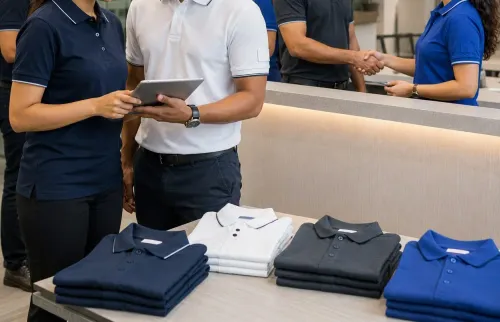



The cheaper shirt on a quotation is not always the cheaper uniform once alterations, samples, replacements, delivery and unused stock are counted. You will be able to compare both routes by landed cost, lead time, garment performance and workforce fit, then choose a practical buying method for your Bangalore office.
Key takeaways
- Choose ready-made shirts for small, urgent orders in standard colours.
- Compare delivered cost, alterations, branding, freight and replacement stock.
- Require matching measurements, fabric details and construction specs from every supplier.
- Approve production only after wash tests and wearer trials.
Start with the decision: standard stock or a controlled uniform programme?
Choose standard stock when you need plain shirts in a common colour, a small quantity, or delivery within weeks. Choose a controlled uniform programme when you need repeatable branding, a non-standard colour, fixed collar or pocket details, women-specific patterns, or planned replacements across locations.
That is the practical decision in custom uniforms versus ready made shirts in Bangalore.
| Dimension | Ready-made shirts | Custom uniforms |
|---|---|---|
| Lead time | Faster when required sizes are in stock | Longer because sampling, fabric booking and production come first |
| Up-front work | Confirm colour, size chart, embroidery and available quantities | Approve patterns, samples, logo placement, fabric, trims and size sets |
| Best fit | Plain corporate shirts and urgent or small orders | Consistent appearance across teams and repeatable replenishment |
| Main risk | Alterations, uneven size availability and colour changes between brands | Minimum quantities, setup costs and excess stock in slow-moving sizes |
Ready made work shirts in Bangalore usually win when the requirement is simple and the supplier can confirm every size, including extended sizes. Do not convert an old shirt size directly; compare actual chest, collar, sleeve and body measurements because S, M and L vary by brand.
Custom uniforms justify the planning when a lower usable-shirt cost comes from fewer alterations, stable replacements and consistent colour over several orders. Include the cost of pattern development, logo setup, sampling, minimum quantities and reserved stock before deciding.
A cheap first order can become expensive when two replacement shirts require a new minimum quantity or arrive in a different dye lot.
Compare the landed cost, not the quoted shirt price
Calculate each option as total cash spent divided by shirts that are actually wearable, not by the quoted unit price. For the first order, add shirt price, GST, freight, logo application, sampling, pattern development, size-set approval, alterations and any minimum-order excess. Unused stock is still a cost.
| Option | First-order calculation | Replacement calculation |
|---|---|---|
| Ready made work shirts in Bangalore | Shirt price + GST + freight + embroidery or printing + alterations + excess sizes | Shirt price + logo cost + freight + alterations + rush charges + dead stock from changed sizes |
| Custom office uniforms in Bangalore | Shirt price + GST + sampling + pattern development + logo setup + size-set approval + production freight + MOQ excess | Replacement shirt + logo cost + freight + MOQ or dye-lot premium + inventory holding |
For ready made work shirts in Bangalore, confirm that every required size is physically available before comparing prices. A low quote becomes expensive when extended sizes require alterations or a second brand with a different colour and fit.
For custom office uniforms in Bangalore, spread one-time setup costs across the first order, then calculate a separate replacement rate. Reserve stock by size, not only by total quantity; a two-shirt reorder can trigger a minimum quantity, dye-lot mismatch or higher delivery charge.
Use the same 12- or 24-month period for both options. Include delivery splits, defect remedies, payment terms and logo durability. If the requirement is a plain shirt in a common colour, ready-made usually wins; non-standard colours, consistent branding and controlled replacements can justify custom production.
Build a specification that makes two suppliers comparable
A comparable specification names the fabric, construction, colour, branding and care requirements in measurable terms. “Premium cotton” and “formal shirt” give suppliers too much room to quote different products.
| Field | Record in the specification | Ready-made check | Custom check |
|---|---|---|---|
| Fabric | Fibre composition, weave, weight in g/m², opacity and shrinkage tolerance; 110–160 g/m² suits many lightweight office shirts | Photograph the fibre and care labels; record the exact style code | Approve the fabric swatch and finished measurements after washing |
| Construction | Collar and cuff design, seam type, stitch density, button material and attachment, pocket dimensions | Inspect a physical shirt, not only a catalogue image | Approve the pattern, seam finish and button sample |
| Colour | Named colour, physical swatch or colour standard, acceptable variation and colourfastness test requirement | Record brand colour code and dye lot for every batch | Retain the approved swatch and require batch matching |
| Logo | Artwork, dimensions, position from seams, embroidery or print method, thread or ink colour and backing | Check the supplier’s actual decorated shirt | Approve a decorated pre-production sample |
| Care | Wash temperature, ironing method, drying restriction and sewn-in care label | Confirm the label matches your laundering process | Specify the label artwork and placement |
For corporate shirt uniforms in Bangalore, require written tolerances for chest, sleeve and shirt length. Ask both suppliers to price the same size range, logo locations and replacement quantities.
Custom uniforms in Bangalore justify the added setup when you need a non-standard colour, fixed collar or pocket design, women-specific patterns or controlled repeat orders. A plain shirt in a common colour can favour ready-made stock.
Use samples, wash tests and wearer trials before approving production
Approve production only after one physical sample survives fitting, washing and a wearer trial; a digital mock-up cannot reveal collar roll, shrinkage or logo distortion.
1. Order a size set in the proposed fabric, colour, collar, pocket and embroidery. Fit employees across body shapes, including women’s sizes, and record chest ease, collar comfort, sleeve length, body length, shoulder movement and tuck-in behaviour. Compare measurements with the supplier’s chart rather than relying on S, M or L labels.
2. Wash each sample using the planned process and water temperature, then measure it again. Check colour change, shrinkage, seam puckering, collar shape, button security, fabric pilling and logo alignment. A logo that looks centred before washing can appear displaced after the shirt or embroidery settles.
3. Run a two-week wearer trial with employees who commute, sit, bend and work through Bangalore’s heat and air-conditioned offices. Ask them to record sweating, transparency, scratchy seams, pocket usefulness, odour retention, ironing effort and whether the shirt remains comfortable after a full day.
4. Repeat the stated wash cycle and photograph the shirts beside an unwashed control. Treat “easy-care” and “wrinkle-free” as unproven until the supplier explains the finish, test method, wash count and whether the care label permits industrial laundering.
Approve only when the trial sample meets written limits for fit, measurement change, colour, appearance and comfort. This evidence protects buyers of corporate shirt uniforms in Bangalore and makes custom office uniforms in Bangalore defensible against ready-made alternatives.
Measure the workforce and plan replacements without creating dead stock
Collect each employee’s chest, waist, shoulder, sleeve and neck measurements, then record the fit they prefer; do not convert an old shirt’s S, M or L label into a supplier size. Indian brands use different measurement charts, so a familiar size can produce a tight chest, short sleeve or excessive body length.
Use one digital form linked to an employee ID. Require a fit sample before production and record the approved shirt size, fit block and alteration note. For a custom office uniforms in Bangalore programme, separate approved patterns for women and men where the trial shows different shoulder, bust, waist or hip requirements.
Keep the measurement process controlled:
- Ask employees to measure over a light shirt, or measure them at a scheduled fitting.
- Offer only the approved fits, such as slim, regular or relaxed, after testing them with wearers.
- Flag maternity needs, mobility requirements and extended sizes for individual review.
- Lock each employee’s final size in a roster that purchasing and HR can access.
Hold replacement stock by size and fit, not by total quantity. Keep a small buffer in common sizes and at least a few units in uncommon sizes; one-off reorders can trigger minimum quantities, dye-lot differences and higher prices. Review issue and replacement records quarterly, removing departed employees before the next order.
For custom uniforms in Bangalore, Colors Inc can use that roster to separate planned replacements from new starters. Store shirts by size, fit and colour batch, with issue dates, so a replacement does not become a guessing exercise.
Frequently asked questions
When should a Bangalore office choose ready-made shirts?
Choose ready-made shirts when you need plain shirts in a common colour, a small quantity, or delivery within weeks.
When are custom office uniforms the better choice?
Choose a controlled uniform programme when you need repeatable branding, a non-standard colour, fixed collar or pocket details, women-specific patterns, or planned replacements across locations.
What costs should you compare besides the quoted shirt price?
Compare the landed cost, including branding, alterations, sampling, freight, taxes, replacement stock and the cost of holding unused sizes.
How should you compare two uniform suppliers?
Give both suppliers the same specification covering fabric, colour, fit, collar, pockets, branding, size range, packaging, delivery terms and quality checks.
What checks should happen before approving production?
Inspect pre-production samples, run wash tests, and ask representative wearers to assess fit, comfort, movement, colour retention and ironing effort.