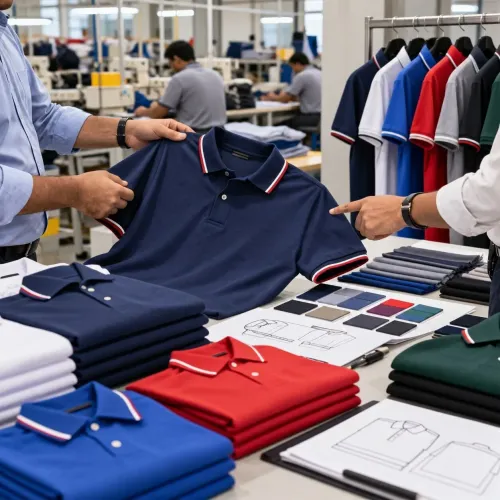



A college choosing between a full-service uniform supplier and a stitching unit is not comparing two prices for the same service. The real choice is between one accountable production partner and a procurement process in which fabric, fit, quality, delivery and replacements are managed separately; by the end, you will have a practical way to choose, specify, quote and inspect the order.
Key takeaways
- Choose one accountable supplier when fabric, trims and delivery need unified control.
- Use direct stitching only when your team can manage materials, patterns and inspections.
- Calculate fabric, transport, rework, supervision and stock costs—not just the stitching rate.
- Approve a sealed sample and written defect liability before placing the full order.
What each model actually controls
A full-service uniform supplier gives the college one accountable party for fabric, trims, patterns, cutting, stitching, finishing, inspection and delivery.
Direct stitching removes that package: the college either supplies approved fabric and measurements to a stitching unit or appoints the unit to coordinate production, while the college or its fabric vendor controls sourcing, shade continuity and replenishment.
| Control point | Full-service uniform supplier | Direct stitching |
|---|---|---|
| Fabric and trims | Supplier books, approves and replenishes materials | College or appointed fabric vendor manages them |
| Pattern and sizing | Supplier develops patterns, grades sizes and prepares samples | College must provide patterns or approve the unit’s development work |
| Cutting and stitching | Supplier schedules both stages under one production plan | Stitching unit cuts only the fabric it receives and produces against the brief |
| Finishing and inspection | Supplier coordinates pressing, thread trimming, checks and packing | College must define inspection points and verify completed garments |
| Delivery | Supplier owns dispatch, batch labels and balance quantities | College coordinates transport, distribution and missing-size follow-up |
| Alterations and replacements | One supplier receives and resolves the claim | College must decide whether the unit, fabric vendor or another party pays |
That is the operational difference behind uniform suppliers versus direct stitching colleges in bangalore: procurement simplicity versus control capacity. Uniform suppliers in bangalore suit colleges without an established fabric source or production coordinator; direct stitching suits a college that can approve shade, manage size curves and control each batch.
Even with a supplier, require class-wise or size-wise packing lists when deliveries are split, so approved and unapproved batches do not reach students together.
Choose by order complexity, deadline and control capacity
A college with a stable repeat pattern, an experienced production coordinator and an approved fabric source can gain control through direct uniform stitching in Bangalore. Without those controls, a full-package supplier is safer, even when its quoted stitching rate is higher.
| Option | Best fit | Main control needed |
|---|---|---|
| Direct uniform stitching | Small or mid-sized intake, limited garment styles, stable size chart and repeat orders | College or appointed fabric vendor controls fabric shade, wastage, patterns, inspection, packing and alterations |
| Full-package supplier | Large student count, broad size range, shirts plus trousers, skirts, blazers or accessories | One supplier must own fabric, trims, grading, production, delivery and replacement accountability |
| Either model | Fixed academic deadline or phased distribution | Approve fit samples early, submit the size curve before cutting and require batch-level packing lists |
Choose direct stitching only when your team can check fabric width, shade continuity and replenishment, approve measurements and chase production daily. A wide size range changes marker efficiency; late size changes create shortages and remnant fabric.
For campus bulk uniform orders in Bangalore, split delivery helps if you can identify each class, department or size group and keep unapproved batches out of distribution. College uniform suppliers in Bangalore suit colleges that value one accountable purchase order over managing several vendors.
Include fabric, sampling, grading, inspection, transport and alteration costs before deciding that direct stitching is cheaper.
Build the specification and production plan before cutting
Before any fabric is cut, issue a purchase order backed by a sealed reference sample, written bill of materials and approved measurement chart. The bill should specify fabric composition, usable width, target GSM, colour reference, construction, buttons or zippers, thread colour, label content, packaging and acceptable tolerances. “Poly-cotton shirt” is not a reproducible specification.
Approve at least one fit sample for every garment style. Record chest, waist, hip, shoulder, sleeve, trouser outseam or inseam and shirt length; a supplier can match the sketch while producing a poor-fitting uniform. Require pre-wash dimensional stability limits, a retained approved swatch and lot-wise shade checks.
Use this control sequence for campus bulk uniform orders in Bangalore:
- Approve the design, measurement chart, fit samples, fabric lot, lab dip, logos and trims in writing.
- Confirm the production trigger in the purchase order. State whether the clock starts after fabric booking, lab-dip approval, size-set approval, purchase-order confirmation or receipt of logos.
- Record separate dates for sample approval, bulk cutting, first delivery and final balance delivery.
- Inspect fabric before cutting, then inspect stitching, measurements, shade and finishing against the sealed sample.
- Permit split deliveries only with batch-level packing lists and carton labels naming the class, department or size group. Keep approved and unapproved batches separate.
- Require a final reconciliation showing delivered quantities, shortages, rejected pieces, alterations and replacement deadlines.
Compare the delivered cost, not the stitching rate
A ₹40 lower stitching rate does not prove a cheaper uniform. Compare the delivered cost per accepted garment: total invoiced and internal order costs divided by the number of garments that pass inspection and reach students.
Uniform suppliers in Bangalore may quote one package covering fabric, trims, patterns, cutting, stitching, finishing, inspection, packing and delivery. Direct uniform stitching in Bangalore may show only the sewing charge, leaving the college to add fabric wastage, pattern making, size grading, cutting, transport and coordination.
| Option | Costs usually included | Costs to add or verify |
|---|---|---|
| Full-package supplier | Fabric, trims, production, inspection, packing and delivery | GST, alterations, replacements and delivery terms |
| Direct stitching unit | Cutting and stitching | Fabric, wastage, sampling, grading, finishing, inspection, packing and transport |
| Fabric vendor plus stitching unit | Fabric supply and job-work production | Shade continuity, fabric movement, rejected pieces and split accountability |
Ask each bidder for the same garment count, size mix and delivery location. Record these items separately:
- Fabric rate, consumption per garment and wastage percentage
- Buttons, zips, labels, embroidery and other trims
- Sample, pattern and grading charges
- Packing, transport, GST and unloading
- Alteration, pickup and replacement charges
Then add the expected cost of rejected or badly sized garments. A quote that excludes liability for shade mismatch, skipped stitches or measurement errors is not comparable until those charges are written into the contract. Use the approved size chart and fit samples when estimating replacement exposure.
Test quality, define liability and protect repeat orders
Approve one signed fit sample for every garment style before bulk cutting. Whether you use college uniform suppliers in Bangalore or a direct stitching unit, attach the approved measurement chart, fabric swatch and decoration artwork to the purchase order.
- Check chest, waist, hip, shoulder, sleeve, shirt length and trouser outseam or inseam against the size set. Record each measurement and approve the permitted deviation in centimetres.
- Inspect the pre-production sample for open seams, skipped stitches, stains, shade mismatch, incorrect embroidery or print placement, faulty zips and loose buttons.
- Define rejection, alteration and replacement rules. Name who pays for rework, pickup, redelivery and garments that fail inspection, and set a deadline for correcting them.
- Release bulk production only after the college signs the sample and inspection method. Keep a signed counter-sample with the purchase team.
For campus bulk uniform orders in Bangalore, allow split delivery by class, department or size group. Require a packing list for each batch and carton labels that separate approved garments from held or rejected stock.
Protect top-up orders by retaining the approved fabric swatch, pattern, graded size chart, trim details and decoration file. Set an alteration window and a replacement contact in the contract. Colors Inc can be evaluated on whether its stitching workflow preserves these records, not simply on its per-piece rate.
A direct unit remains manageable only when the college assigns someone to own the same records, inspections and replenishment approvals.
Related service
college uniforms We undertake uniforms stitching for both men and Women View service → |
Frequently asked questions
What does a full-service uniform supplier control?
A full-service supplier controls fabric, trims, patterns, cutting, stitching, finishing, inspection and delivery through one accountable party.
When is direct uniform stitching suitable for a college?
Direct stitching suits a college that can source fabric and trims, approve patterns, supervise production, inspect garments and coordinate delivery itself.
How should colleges compare uniform suppliers with direct stitching?
Compare the delivered cost, including fabric, trims, transport, supervision, inspection, alterations, rework, wastage and stock handling—not only the stitching rate.
What should a college approve before a bulk uniform order?
Approve a sealed sample, written measurements, fabric and colour specifications, inspection standards, delivery milestones and defect liability before cutting begins.