


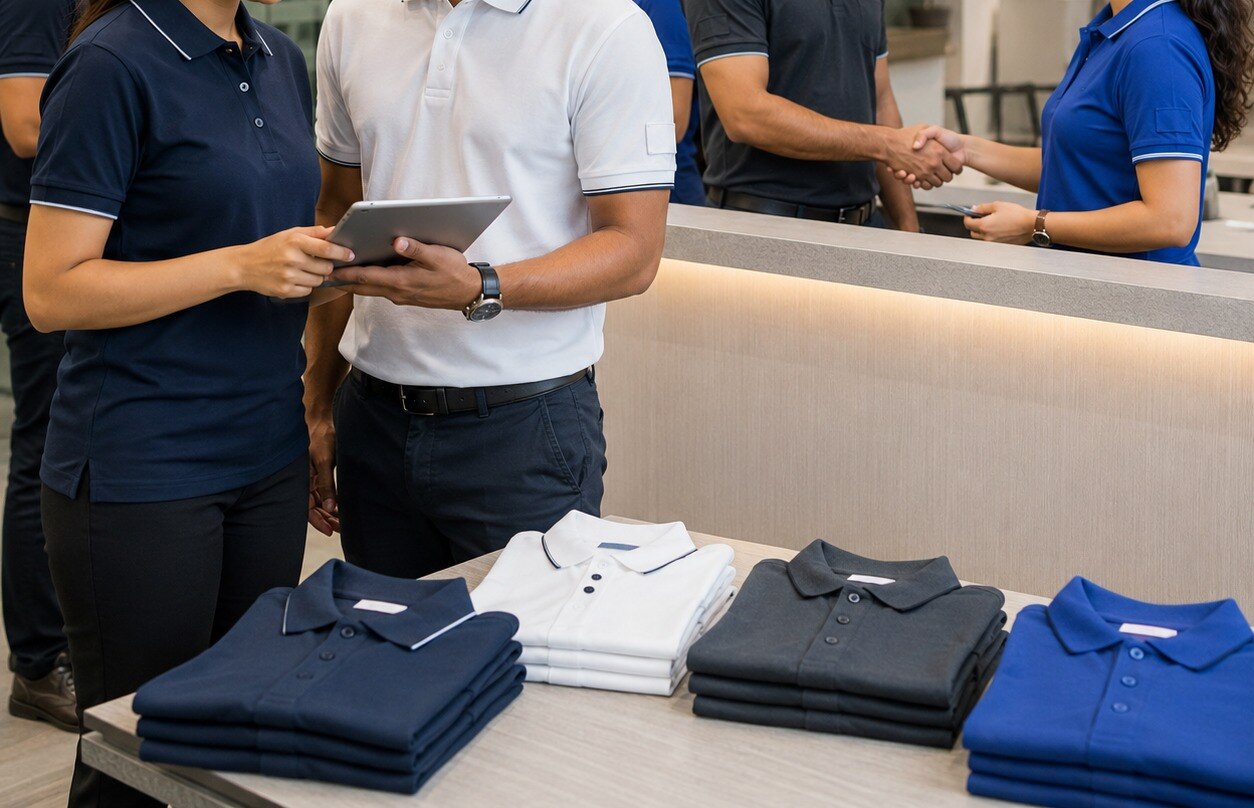
A new Bangalore office must coordinate headcount, garment design, sizing, branding and delivery before its first employees arrive. Use the buying process below to compare suppliers, approve production properly and phase new office team uniforms without paying for avoidable alterations, replacements or rushed orders.
Key takeaways
- Start sourcing eight to ten weeks before employees join.
- Request a complete size set and run wearer try-ons before production.
- Test fabric shrinkage, colourfastness and embroidery after washing.
- Compare itemised quotations, samples, lead times and payment terms.
Set the sourcing timetable before employees join
Contact suppliers eight to ten weeks before the first employees join, and set delivery for seven to ten days before issue day. That window covers supplier comparison, a complete size set, wearer try-ons, corrections, production, wash checks and packing. Add two weeks for jackets or complex embroidery.
1. Week 1: Send the brief to uniform suppliers and t shirt manufacturers in Bangalore. State garment types, quantities by joining wave, logo method, fabric, size range, required delivery date and intended laundering method.
2. Weeks 2–3: Ask uniform suppliers in Bangalore for a measurement chart, production address, monthly capacity, sample timeline and replacement policy. Confirm whether the supplier manufactures, sources ready stock or uses subcontractors.
3. Weeks 3–4: Approve a pre-production size set containing every proposed size. Have representative employees try each size; chest, shoulder, sleeve and body length can differ between Indian size charts.
4. Weeks 5–8: Release bulk production only after approving the size set, artwork proof and washed sample. Keep a seven-day receiving buffer for counting, inspection and replacements.
Order for the first joining group plus a small reserve, then schedule later batches against confirmed start dates. This avoids paying for unneeded new office team uniforms while protecting late joiners from a rushed, mixed-quality order. Require separate packing counts by garment, size and department so HR can issue kits without reopening every carton.
Compare supplier capabilities before choosing the garment mix
A catalogue proves design range, not production capability. Ask each supplier who cuts, stitches, decorates and inspects the garments before you compare prices.
| Supplier model | What it can cover | Evidence to request |
|---|---|---|
| In-house manufacturer | Pattern development, cut-and-sew production, sampling and repeat orders | Factory address, monthly capacity, measurement chart and sample approval process |
| Sourcing or trading supplier | Ready-stock sourcing and subcontracted stitching or decoration | Subcontractor address, named quality-responsible party and replacement policy |
| Decorator | Printing or embroidery on purchased garments | Blank-garment source, artwork proof, adhesion test and responsibility for garment defects |
Ask uniform suppliers and T-shirt manufacturers in Bangalore to separate these stages in the quotation:
- Fabric knitting and dyeing
- Cutting, stitching and finishing
- Printing or embroidery
- Packing, delivery and alterations
This prevents a decorator from appearing equivalent to a cut-and-sew factory. It also exposes different levels of control over fabric shade, collar recovery, seam strength and skipped stitches.
Request a measurement chart with tolerances, fabric test information and one washed sample. Test it using the laundering method employees will follow; record shrinkage after washing, tumble drying and pressing rather than approving an unwashed garment.
For branded garments, approve the artwork proof and inspect logo adhesion, embroidery density and shade consistency. Ask how defective pieces are replaced and who pays for rework.
Verify the legal entity, GST details, billing address, bank account and production arrangement before paying an advance. A GST or Udyam check confirms registration, not factory ownership or quality.
Choose fabrics, garments and branding for Bangalore working conditions
A client-facing role needs a sharper silhouette than a back-office role, but every garment must survive Bangalore’s heat, humidity and monsoon travel. Choose breathable knits for daily wear, light layers for air-conditioned rooms and darker lower garments where dust and rain marks show quickly.
| Role | Recommended combination | Fabric and branding |
|---|---|---|
| Client-facing sales or reception | Formal shirt, trousers and lightweight jacket | 100% cotton or cotton-rich poplin; embroidered logo on shirt, woven label or subtle embroidery on jacket |
| Finance, HR or administration | Formal shirt and trousers, with a jacket for meetings | Easy-care cotton-polyester blend; tonal embroidery at the chest |
| Engineering or operations | Polo T-shirt and trousers | Cotton piqué or cotton-polyester piqué; embroidered logo that will not peel |
| Internal technology or creative teams | Polo T-shirt and crew-neck T-shirt, with optional jacket | 160–200 GSM cotton or cotton-rich jersey; screen print for large artwork, embroidery for small logos |
| Events, onboarding or casual support | Crew-neck T-shirt and trousers or chinos | 160–180 GSM combed cotton; screen-printed campaign artwork |
For new office team uniforms, specify finished GSM, colour reference, collar or neck construction, seam type and logo method rather than “premium polo” or “cotton T-shirt”. Ask T-shirt manufacturers in Bangalore to identify knitting, dyeing, cutting, stitching, finishing and decoration separately; a decorator that only prints purchased garments offers a different level of control.
Keep the artwork small on formalwear, and reserve large prints for crew-neck T-shirts used at events.
Control sizing, samples and wash performance before bulk production
Approve a pre-production size set, not a single attractive sample. For new office team uniforms, include every proposed size and hold a try-on with representative employees; chest, shoulder, sleeve and body length can differ sharply between manufacturers’ Indian size charts.
1. Record the specification before bulk office uniform stitching: fabric composition, finished GSM, knit structure, colour reference, collar or neck construction, seam type, logo method, measurement chart with tolerances and packing method.
2. Measure each size after the intended laundering method. Set a maximum shrinkage allowance, then wash samples using the planned temperature, tumble-drying and pressing process. Check chest, length, sleeve, collar recovery and overall shape after washing.
3. Inspect construction under good light. Reject skipped or open stitches, puckering, weak seams, uneven hems, loose threads and inconsistent collar shape. Compare dyed panels and garments against the approved colour reference to catch shade variation.
4. Test the logo on a washed sample, not only on an unworn garment. Check embroidery for thread pull-out and distortion; check print for cracking, peeling, bleeding and loss of adhesion after repeated laundering.
5. Approve the artwork proof and final sample in writing, then record the accepted measurements, colour, logo position, wash result and packing counts. Put the replacement policy for defective or incorrectly sized garments in the purchase order.
If an employee falls between sizes, approve an alteration or made-to-measure route before ordering. Durable fabric or a bright colour does not make ordinary office clothing protective equipment; specify a hazard and protective-clothing standard only when protection is genuinely required.
Compare quotations and verify the supplier before paying an advance
Before paying an advance, make every quotation comparable and every approval traceable. Ask uniform suppliers in Bangalore to price the same fabric, construction, branding, quantities, size mix, packaging and delivery date—not merely “uniforms” or “bulk office uniform stitching.”
| Area | Quotation must show | Purchase order must lock |
|---|---|---|
| Garment | Fabric composition, GSM, colour code, measurements and tolerances | Approved size set, measurement chart, shade and fabric reference |
| Work | Cutting, stitching, finishing, printing or embroidery listed separately | Decoration artwork, placement, thread or ink specification |
| Cost | Unit rate, GST, sampling, alterations, freight and replacement charges | Total value, tax treatment, payment stages and delivery milestones |
| Quality | Wash test, shrinkage allowance and defect standard | Bulk production only after written approval of sample and wash result |
Split the first order into a paid development or pilot stage and bulk production. Require testing after the intended laundering method; specify maximum shrinkage, washing temperature, tumble-drying limits and pressing instructions. Unwashed approval alone can hide length loss, collar distortion or shade change.
- Confirm the legal entity name, GSTIN and billing address; verify the GSTIN on the government GST portal.
- Check any Udyam registration claim on the official Udyam portal.
- Match the bank-account name to the contracted entity before transferring funds.
- Ask whether fabric knitting, dyeing, cutting, stitching and logo application happen in-house or through named subcontractors.
- Put replacement deadlines and packing-count checks in writing.
Colors Inc should provide the same documentation if considered for the order. A GST or Udyam check confirms registration, not production quality, so inspect the approved sample and supplier references before releasing the balance.
Related service
college uniforms We undertake uniforms stitching for both men and Women View service → |
Frequently asked questions
When should you contact uniform suppliers for a new Bangalore office?
Contact suppliers eight to ten weeks before employees join, with delivery scheduled seven to ten days before issue day. Add two weeks for jackets or complex embroidery.
What should you compare before choosing a garment mix?
Compare each supplier’s sampling process, bulk office uniform stitching capacity, embroidery and printing methods, size range, production lead time and quality controls.
Which fabric and branding factors suit Bangalore working conditions?
Assess breathability, drying time, colourfastness, garment weight and care requirements. Choose embroidery, screen printing or heat-transfer branding based on fabric, design detail and expected washing.
How can you control sizing and wash performance before bulk production?
Order a complete size set, run wearer try-ons, record corrections and wash sample garments before approving bulk production. Check measurements, shrinkage, colour change, seam strength and branding adhesion.