

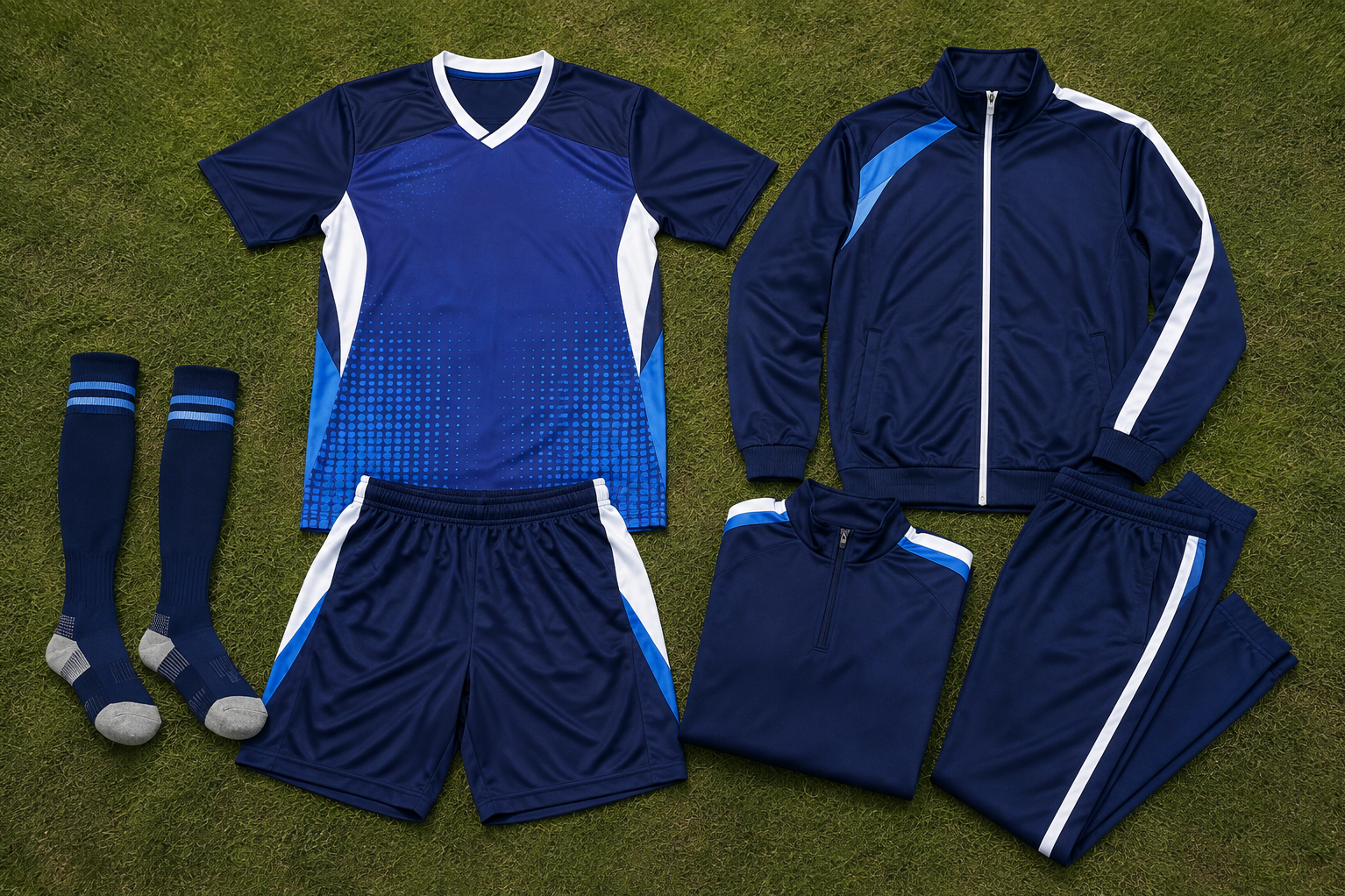
Sports uniforms need to do more than make a team look coordinated. Players run, stretch, jump, turn, and train for extended periods, which means garment comfort and movement can directly affect the wearing experience.
Organizations comparing sports team uniform manufacturers in Bangalore should evaluate fabric, fit, printing, sizing, and repeat-order capability before choosing a supplier.
Match the Uniform to the Sport
A cricket uniform does not have the same requirements as a football jersey, basketball kit, athletics top, or training T-shirt.
Before selecting a design, teams should define where and how the garment will be used.
Questions worth considering include:
- Is it intended for competition or training?
- Will players primarily compete indoors or outdoors?
- How much physical movement does the sport involve?
- Does the team require jerseys, shorts, trousers, tracksuits, or multiple pieces?
- Will player names and numbers change regularly?
- Are junior and adult sizes required?
Answering these questions narrows the specification before design decisions begin.
Compare Fabrics Based on Performance Requirements
Sportswear is exposed to sweat, movement, repeated washing, and frequent use.
Lightweight fabric may be desirable for active sports, but teams should also consider garment durability and the type of decoration being applied.
Before ordering, ask for fabric information and, where possible, evaluate a sample physically. The fabric should be considered in the context of Bangalore and Karnataka's playing conditions, particularly for outdoor sports.
Evaluate Printing and Branding Carefully
Team uniforms often contain more visual elements than corporate workwear.
These may include:
- Team logos
- Player names
- Jersey numbers
- Sponsor branding
- Club colours
- School or company identity
The appropriate decoration method depends on the garment and design. Rather than assuming one printing technique is suitable for everything, teams should discuss artwork complexity, expected use, fabric, quantities, and washing requirements with the manufacturer.
Artwork should also be finalized carefully before production. Incorrect numbers or spelling can create avoidable replacement costs.
Fit and Size Availability Can Become a Major Issue
Sports teams often include players with significantly different body measurements.
An attractive design can quickly become problematic when suitable sizes are unavailable. Teams should obtain the supplier's size chart and confirm whether children's, adult, and extended sizes are available when required.
For important tournament orders, trying sample sizes before confirming quantities can reduce fitting problems.
Consider Reorders Before Selecting a Supplier
A team may initially order uniforms for 20 players and later need additional garments for new members or replacements.
Ask whether the design, fabric details, artwork, colours, and size specifications can be retained for future reference.
This becomes particularly valuable for academies, schools, clubs, and corporate sports teams that use the same identity across multiple seasons.
Compare the Complete Offer Rather Than Only Price
The lowest per-piece quotation does not automatically represent the best value.
When comparing sports team uniform manufacturers in Bangalore, examine what the quotation actually includes. One supplier may include customization while another may price player names, numbers, artwork changes, or packaging separately.
Teams should compare equivalent specifications before making a decision.
Colors Inc supports customized uniform requirements for organizations and teams in Bangalore. A clear sportswear brief containing garment type, sizes, artwork, quantity, usage, and required delivery schedule can help make the production discussion more precise.
The best sports uniform is not simply the one that looks impressive before a match. It should remain comfortable during activity, identify the team clearly, suit the sport, and be manageable when replacements are required.
For sports organizations across Bangalore and Karnataka, evaluating these practical factors before ordering can reduce sizing problems, artwork errors, and inconsistent future batches.